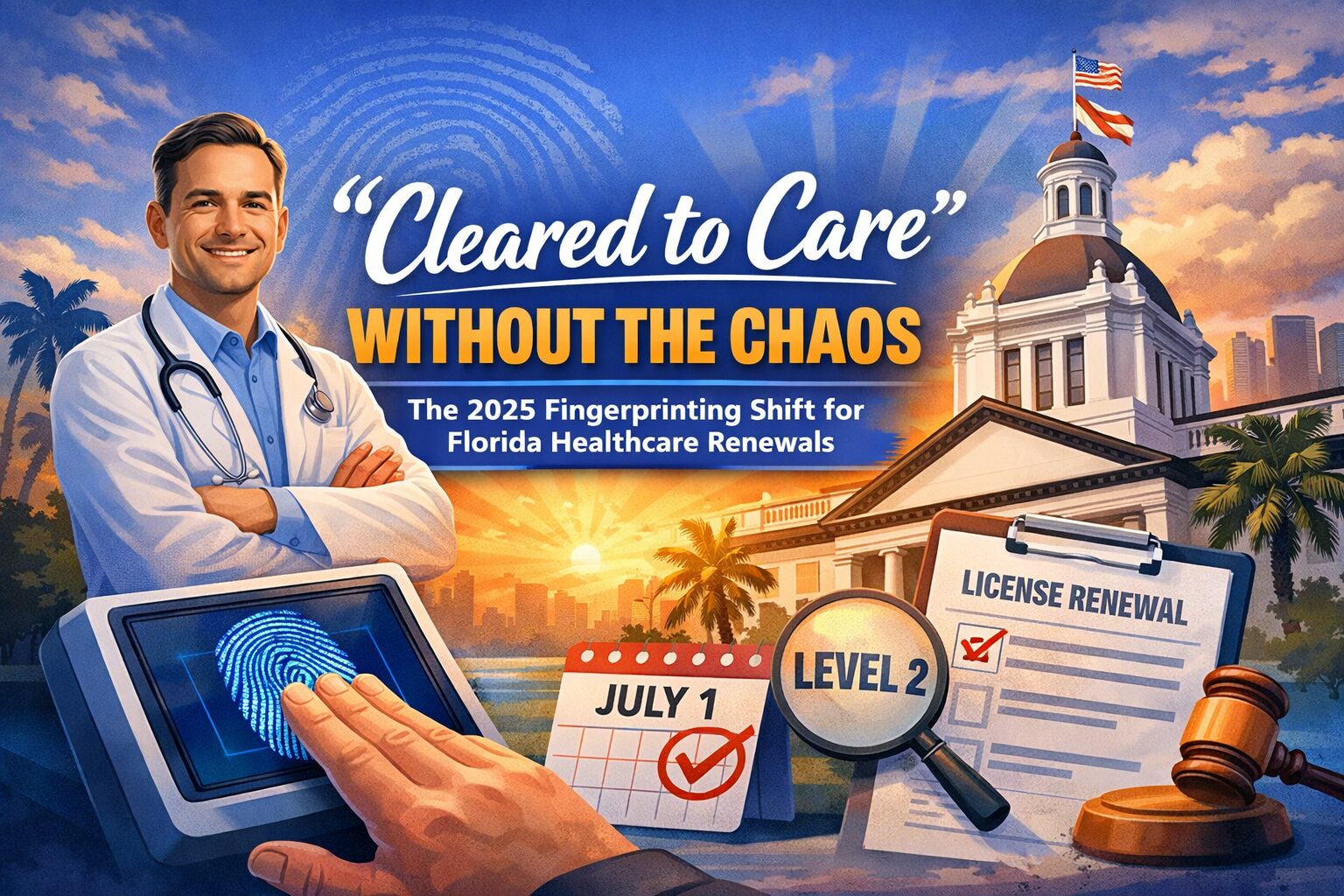
“Autorizado para atender” sin caos: el cambio en la toma de huellas dactilares para las renovaciones de seguros médicos en Florida en 2025
Florida cambió las reglas del juego, discretamente. A partir de 1 de julio de 2025, Muchos profesionales de la salud que anteriormente estaban exentos de los requisitos de toma de huellas digitales electrónicas ahora deben completar un LiveScan de nivel 2 como parte de la renovación de su licencia. Este cambio proviene de Proyecto de ley 975 de la Cámara de Diputados, que vincula la elegibilidad para la renovación al cumplimiento de las normas actualizadas de verificación de antecedentes penales en virtud de §456.0135, Estatutos de Florida.
Las buenas noticias: Por lo general, esto no causa ningún problema cuando se hace correctamente. La mala noticia es que, si se hace incorrectamente, se convierte en un pasatiempo accidental. Mantengámoslo en la categoría de “sin problemas”.
Si obtuvo su licencia antes de enero de 2013, es posible que haya vivido cómodamente sin tener que cumplir con los requisitos del centro de intercambio de información digital del estado. Ya no es así. El Departamento de Salud de Florida puede prohibir la renovación de su licencia hasta que se tomen sus huellas digitales de nivel 2 y se ingresen correctamente en el sistema del estado.
Por qué Florida hizo esto
La intención es clara: Estandarizar la verificación de antecedentes en todas las profesiones sanitarias reguladas y reducir las brechas creadas por los plazos heredados. La HB 975 actualiza el marco de renovación para que los profesionales sean evaluados de manera coherente, no solo “al principio”, sino de una manera que respalde el cumplimiento continuo y la confianza del público.
Si desea leer directamente el texto legal, aquí lo tiene: Texto oficial del estatuto.
Desde nuestro punto de vista, esto encaja con la misma mentalidad moderna de “identidad de alta confianza” que utilizamos en otros flujos de trabajo, incluyendo Garantía de identidad basada en KYC — porque la forma más rápida de crear problemas de renovación es la incertidumbre sobre la identidad, el enrutamiento o la retención de registros.
Lo que necesita saber para una renovación sin estrés
Aspira a 90-120 días antes de la fecha de vencimiento. Ese margen es la diferencia entre “listo” y “¿por qué mi renovación está en el limbo?”. Si lo gestionas con antelación, tendrás tiempo para tramitarlo y hacer pequeñas correcciones sin prisas.
Una vez que estás en el sistema, tus huellas dactilares se conservan durante un periodo determinado (normalmente 5 años). Para mantenerlas activas para su renovación, el FDLE puede exigir un $43.25 cuota de retención cuando su retención expira durante un ciclo de renovación. Si la retención caduca, se le puede obligar a realizar una nueva presentación de LiveScan, lo que supone una repetición innecesaria.
 IMPORTANTE: El ORI de tu placa es importante. Un ORI incorrecto = destino incorrecto = pérdida de tiempo.
Rara vez se debe al resultado de la verificación de antecedentes. Los retrasos suelen deberse a una de estas tres causas: ORI incorrecto, desajustes demográficos (nombres/fechas/identificaciones ingresados de manera inconsistente), o esperar hasta el último momento. En otras palabras: cosas que se pueden prevenir.
Si un proceso puede arruinarse por un solo número incorrecto, asume que ese número aparecerá en el peor momento posible. Entonces haz lo contrario: verifica el ORI, captura impresiones limpias y date un margen de tiempo. Tu yo futuro te enviará una nota de agradecimiento.
La manera más rápida de hacerlo (sin conjeturas)
Si quieres obtener información detallada sobre qué llevar, cómo funciona LiveScan, qué significa “Nivel 2” en la vida real y qué debes evitar, empieza aquí: Toma de huellas dactilares LiveScan en Daytona Beach
Respuestas rápidas que la gente realmente necesita
Se trata de un cambio de proceso, no de un reto personal. Si lo gestionas a tiempo y lo encauzas correctamente, obtendrás la “autorización para atender” sin dramas, que es como siempre deberían ser las renovaciones.