Por qué los formularios electrónicos de la ATF se rechazan con mayor frecuencia en 2026
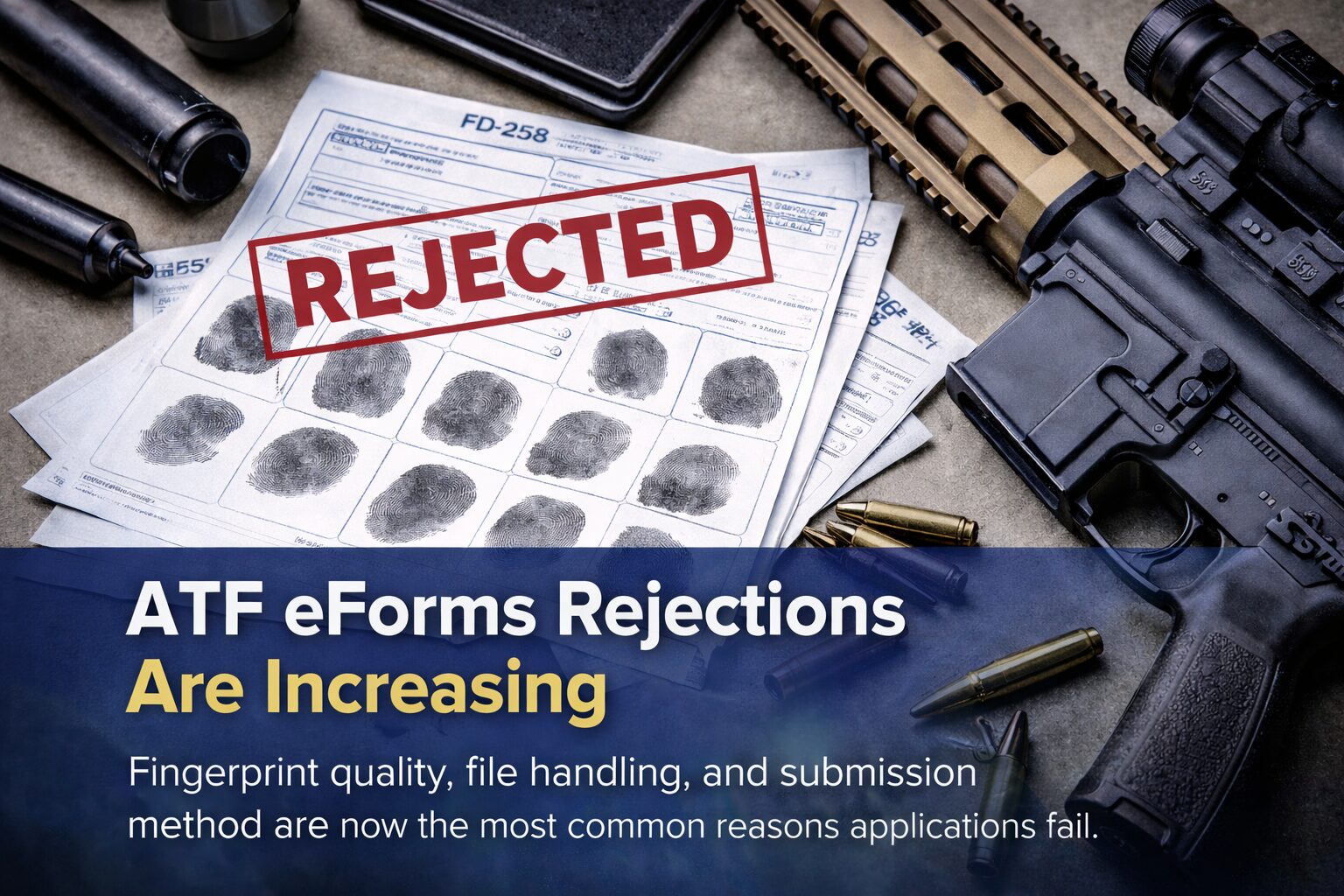
ATF eForms está experimentando un aumento en el número de solicitudes presentadas en 2026, y los problemas con las huellas dactilares son ahora una de las principales causas de rechazo de las solicitudes de los formularios 1 y 4.
La eliminación del timbre fiscal $200 trajo consigo una oleada de nuevos solicitantes al Sistema de formularios electrónicos de la ATF. Solicitar un supresor o un rifle de cañón corto es más accesible que nunca, pero el proceso en sí no se ha vuelto más flexible.
A medida que más personas envían sus solicitudes, las huellas dactilares de los formularios electrónicos de la ATF se están convirtiendo en uno de los puntos más comunes de falla. Muchos solicitantes dan por sentado que sus huellas son aceptables, solo para encontrarse con retrasos o rechazos más adelante en el proceso.
Cada vez más, la diferencia entre la aprobación y el retraso se reduce a cómo se manejan los datos de huellas dactilares y si se utiliza un archivo EFT en lugar de las tarjetas tradicionales.
Descripción general de los formularios electrónicos de la ATF
ATF eForms es el sistema utilizado para enviar solicitudes de los formularios 1 y 4, incluidos los supresores y los SBR. A medida que aumenta el volumen de envíos, el sistema depende cada vez más de datos dactiloscópicos coherentes y de alta calidad, especialmente cuando se envían digitalmente.
Formularios electrónicos de la ATF Huellas dactilares y problemas comunes de rechazo
La mayoría de los problemas de rechazo de huellas dactilares en los formularios electrónicos de la ATF no se deben a un error grave, sino a pequeños fallos a lo largo del proceso.
- Tarjetas de huellas dactilares FD-258 con detalles débiles de las crestas.
- Escaneos de baja resolución que reducen la claridad.
- Compresión de archivos que altera los datos de huellas digitales.
- Información demográfica no coincidente
- No se cumplieron los plazos para enviar las tarjetas de huellas dactilares.
Estos problemas se evitan cada vez más utilizando un Archivo de huellas dactilares EFT para formularios electrónicos ATF, lo que elimina por completo muchas de estas variables.
Por qué las tarjetas de huellas dactilares FD-258 suelen fallar
La tarjeta de huellas dactilares FD-258 en sí misma es confiable, pero el flujo de trabajo que la rodea presenta riesgos.
Muchos solicitantes recurren a escáneres básicos de oficina o a establecimientos minoristas. Estos métodos degradan la calidad de las huellas dactilares de formas que no son evidentes, pero que aún así afectan al resultado final.
Los flujos de trabajo controlados (escáneres planos de alta resolución, impresión de tarjetas de precisión y manejo adecuado de archivos) son fundamentales. Esto es especialmente importante a la hora de convertir tarjetas físicas a formatos digitales.
Por este motivo, muchos solicitantes están dejando de lado por completo los flujos de trabajo basados en tarjetas y utilizando desde el principio archivos EFT digitales.
Riesgos de las huellas dactilares del formulario 1 y del formulario 4
Tanto si envía las huellas dactilares del formulario 1 para un SBR como las del formulario 4 para un supresor, los riesgos son los mismos.
El envío por correo de las tarjetas de huellas dactilares plantea un problema de tiempo. Si no llegan dentro del plazo establecido, la solicitud puede ser rechazada independientemente de su exactitud.
Esta es una de las causas más comunes y evitables del rechazo de los formularios electrónicos de la ATF, y una que los archivos EFT eliminan por completo.
Por qué los archivos de huellas dactilares EFT se están convirtiendo en el estándar
Un archivo de huellas digitales EFT para los formularios electrónicos de la ATF simplifica el proceso y elimina los puntos de fallo más comunes.
- Sin retrasos en el envío ni tarjetas de huellas dactilares perdidas.
- Sin pérdida de calidad por escaneo o conversión.
- Carga directa en los formularios electrónicos de ATF
- Reutilizable para futuras solicitudes de supresores o SBR.
Para muchos solicitantes, utilizar un archivo EFT es la forma más confiable de evitar por completo los problemas relacionados con las huellas dactilares.
ATF eForms sigue evolucionando a medida que aumenta el volumen de envíos, lo que hace que la calidad de las huellas dactilares y el método de envío sean más importantes que nunca.
Inicie el proceso de toma de huellas dactilares de ATF eForms.
Si está preparando un Formulario 1 o un Formulario 4 y desea evitar problemas con las huellas dactilares desde el principio, puede comenzar aquí:
Servicios de toma de huellas dactilares ATF EFT