
Florida Document Specialists • Daytona Beach LiveScan
Difficult Fingerprints? Why Some Fingerprints Are Hard to Capture — and What You Can Do
If you have faint, worn, or previously rejected fingerprints, getting them captured for a license, background check, or clearance requires specialized tech and experience—not a push-button transaction.
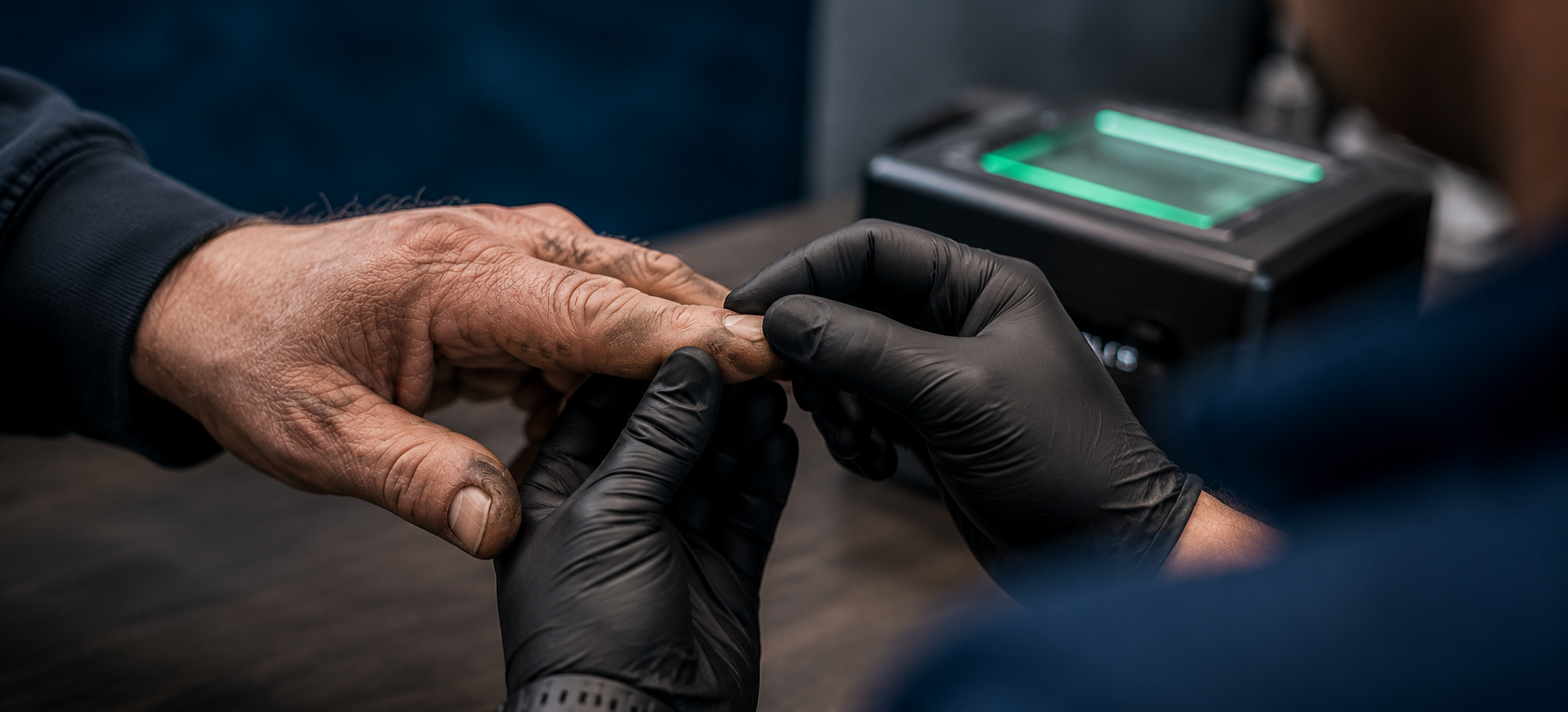
Understanding Hard-to-Scan Prints
If you’ve been told that your fingerprints are difficult to capture, had fingerprint cards rejected for poor quality, or already know that your fingerprints are faint, worn, or difficult to scan, you are not alone.
Some people are simply much harder to fingerprint than others. Age, years of working with your hands, chemical exposure, dry or damaged skin, calluses, injuries, and other factors can make fingerprint ridges difficult for electronic scanners to capture clearly.
And if your fingerprints are needed for a professional license, employment background check, immigration matter, government clearance, or another time-sensitive purpose, a rejected set of prints can be much more than an inconvenience. The quality of your fingerprint capture can mean the difference between acceptance and meeting an important deadline, or rejection, delay, and potentially a lost opportunity.
Beyond a Transaction
That’s why difficult fingerprints should never be treated as just another push-button transaction. At our Daytona Beach office, Florida Document Specialists gives difficult prints their best practical chance of producing usable, accepted images.
Looking for Someone Who Can Take Difficult Fingerprints?
If you’re reading this because you’ve already had fingerprints rejected, you’ve been told you have “bad fingerprints,” or you’re searching for someone experienced with worn, faint, elderly, damaged, or difficult-to-capture fingerprints, you’ve come to the right place.
At Florida Document Specialists, difficult fingerprints aren’t an unusual interruption to our normal process. They’re something our fingerprinting program was specifically designed and equipped to handle.
We can’t manufacture fingerprint ridges that no longer exist, and no reputable fingerprint provider should promise that every person’s prints can be successfully captured. What we can do is give difficult fingerprints their best practical chance of producing usable images. That begins with understanding why some fingerprints are difficult in the first place.
Our Daytona Beach office utilizes specialized skin preparation, specialized capture techniques, and dual sensor technologies to maximize ridge clarity where standard counters fail.
Why Fingerprints Become Hard to Capture
Understanding what causes poor ridge detail is the first step toward executing a successful, acceptable LiveScan submission.
Age-Related Skin Changes
As we age, skin becomes thinner, drier, and less elastic. Ridges flatten and fine lines interfere with electronic scanners. Simply pressing harder flattens faint ridges further, making the image worse.
Occupational Wear & Tear
Construction, mechanics, trade work, and landscaping cause repeated physical abrasion. Heavy calluses obscure natural ridge patterns or prevent scanners from obtaining uniform contact.
Chemical & Moisture Exposure
Frequent sanitizing, healthcare handwashing, solvents, cleaners, and adhesives take a severe toll over time, leaving fingertips extremely dry, peeling, or damaged.
Where the Fingerprint Technician Matters
For someone with strong, easily captured fingerprints, almost any setup works fine—place your fingers, get a green light, and move on. That apparent simplicity is why fingerprinting has become an add-on service at shipping stores and retail counters, where an employee might bubble-wrap a package thirty seconds before scanning your prints.
However, digital systems evaluate ridge clarity against strict federal algorithms, such as the NIST Fingerprint Image Quality standards. For applicants with worn, faint, or difficult fingerprints, there is a lot wrong with a automated push-button model. When a rejected submission means a missed deadline or lost career opportunity, repeatedly placing the same finger on the same scanner and hoping for a different result isn’t a technique.
A trained fingerprint technician needs to evaluate: Is the skin too dry or moist? Is excessive pressure flattening ridges? Are calluses interfering? Would preparing the skin differently or switching technologies help? The scanner is a tool. The technician is the professional.
The Critical Difference
Operating a scanner and understanding fingerprints are not the same skill. When fingerprints are easy, you may never notice the difference. When they are difficult, it matters enormously.
Two Capture Technologies
Difficult skin and ridge characteristics don’t behave identically across sensor types. Having options prevents endlessly repeating failed scans.
Thales DactyScan
Uses high-precision optical fingerprint capture technology, providing clean, high-contrast imaging for clear-to-moderate ridge structures.
Integrated Biometrics Kojak
Features LES (Light Emitting Sensor) film technology, interacting differently with problematic skin to capture detail conventional optics miss.
Specialized Hydration
We maintain specialized topical products to treat temporary skin conditions instantly, giving shallow or dry ridges the moisture contrast required for a clean capture.
A Program Built Around Law Enforcement Experience
Our fingerprinting program was developed and is supervised by John Bayne, a retired police sergeant with 30 years of law-enforcement experience.
During his career, John took thousands of fingerprints and received advanced training in evidence and crime-scene procedures, including completion of the Florida Department of Law Enforcement Advanced Crime Scene Procedures course. Our operational protocols strictly align with state-level compliance outlined under official FDLE background check guidelines.
Florida Document Specialists is a family business. Our technicians are personally trained in techniques for recognizing and working with difficult ridge detail—and when a set of prints requires extra attention, John’s direct supervision and experience are always available.
Can We Guarantee Acceptance?
No—and we’d be suspicious of anyone who did. No technician can create ridges that no longer exist. Our objective is to give your prints their best practical opportunity before concluding they cannot be captured.
Preparing for Your Fingerprint Appointment
If you already know your prints are difficult, or if you’ve been turned away elsewhere, telling us ahead of time allows us to select the proper technology and skin-prep protocols before we scan.
Already had your fingerprints rejected? Tell us.
If you’ve previously received a fingerprint rejection for poor quality, don’t keep it to yourself when you schedule another appointment with Florida Document Specialists. Tell us in advance! If you have a formal rejection notice explaining why your prints were rejected, bring that document with you as well.
What conditions should you notify our technicians about?
Please let us know prior to scanning if you have ever been told you have:
- Faint or worn fingerprints
- Poor ridge detail or prints that “won’t scan”
- Fingerprints previously rejected for poor image quality
- Heavily callused fingers or occupational wear
- Extremely dry, cracked, or damaged fingertips
- Age-related fingerprint wear
Sharing this information allows us to approach your capture as a challenging case right from the start rather than discovering it halfway through your session.
Why shouldn’t you wait for a rejection to seek an expert?
A rejected fingerprint submission can cost days or even weeks. If you’re working against a professional licensing, employment background, immigration, or legal deadline, those lost days can mean lost opportunities. The time to find an experienced fingerprint technician is before an avoidable rejection—not after one.
When the Fingerprints Matter, So Does the Fingerprinting
Most fingerprint appointments are routine. Some aren’t.
If you’re being fingerprinted for a new career, professional license, government requirement, FBI background check, immigration matter, or another important purpose, the fingerprint appointment may represent one very small step in a much larger process. But when that small step fails, everything behind it can stop.
For applicants with known fingerprint difficulties, choosing an experienced fingerprint provider can mean the difference between obtaining the best fingerprints your hands are capable of producing and simply running the same difficult fingers across another scanner.
Florida Document Specialists provides professional LiveScan fingerprinting in Daytona Beach, including FDLE Level 2 background checks, FBI Identity History Summary fingerprinting, FD-258 fingerprint cards, and other fingerprinting services. If you already know your fingerprints are difficult, worn, faint, or have been rejected before, tell us when you make your appointment. We’ll know exactly why that matters.
Schedule Your Fingerprint Appointment in Daytona Beach
Don’t let worn, faint, or difficult fingerprints delay your license, job, or clearance. Contact Florida Document Specialists today to ensure your capture gets the time, technology, and expertise it deserves.
Learn More & Schedule AppointmentFrequently Asked Questions About Difficult Fingerprints
If you're concerned about faint ridges, previous rejections, or age-related skin wear, here are quick answers to what you can expect during your appointment.
Can faint or worn fingerprints still be successfully scanned?
In many cases, yes. While no provider can create ridge detail that has been permanently lost, using alternative sensor technologies (such as LES film sensors), specialized topical skin conditioners, and proper finger positioning can often produce a compliant image where standard optical scanners fail.
What happens if my LiveScan fingerprints are rejected by FDLE or the FBI?
If your fingerprints are rejected due to poor image quality, you will typically receive a formal rejection notice containing a TCN (Transaction Control Number) or TCR number. Bringing this notice to your re-scan appointment allows us to utilize specialized capture settings and alternative equipment tailored for difficult skin.
Why does pressing harder make faint fingerprints worse?
Applying excessive pressure flattens the narrow valleys between your fingerprint ridges, causing them to merge together into a dark, unreadable smudge on the digital scanner. Delicate, faint ridges require calibrated pressure and specific moisture balance rather than force.
Should I moisturize my hands before my fingerprinting appointment?
We recommend avoiding heavy lotions, silicones, or oil-based moisturizers immediately before your appointment, as these can leave a film on the scanner glass. Our technicians use specialized, rapid-absorbing topical solutions in the office specifically formulated for fingerprint scanning if your skin is overly dry.