FDLE vs Level 2 vs AHCA: How to Choose the Right Background Check

What's the difference between FDLE and FDLE Level 2 with AHCA?

Livescan | FDLE | AHCA | ORI Numbers

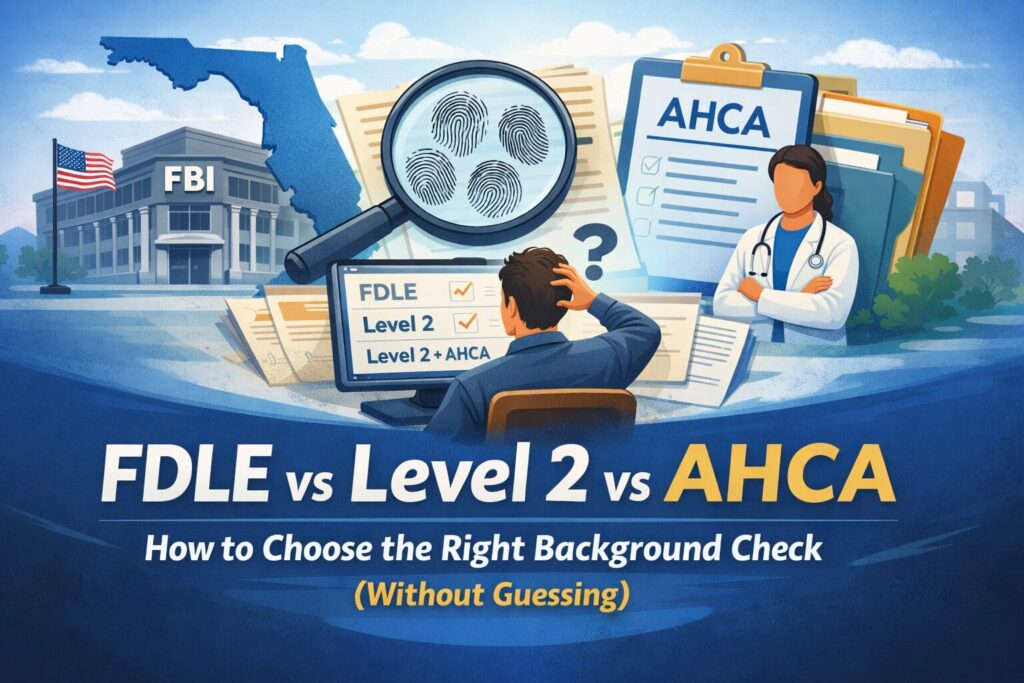
FDLE vs Level 2 vs AHCA: How to Pick the Right Background Check (Without Guessing)

A practical guide for employers, applicants, and anyone stuck on our intake form.

Start here if you’re stuck on the intake form

If you’re trying to choose between FDLE, FDLE Level 2, or FDLE Level 2 with AHCA, don’t guess. The “right” option is whatever the requesting employer, licensing board, or agency requires.

The one question that decides everything:

Do you need Florida-only results, or Florida + FBI (national) results?

  • An ORI number does NOT tell you which option to pick. An ORI is primarily where the results are routed.
  • If FBI results are required, it is Level 2.
  • If FBI results are not required, it is not Level 2 — even if fingerprints are taken.

In some cases, the paperwork decides for you:

  • If your paperwork mentions a “Screening ID” or the “Background Screening Clearinghouse,” that typically indicates a Level 2 process (Florida + FBI) tied to a registered screening record. Important: “Clearinghouse” language does not automatically mean AHCA applies.
  • If your instructions or paperwork specifically say “AHCA” or “Agency for Health Care Administration,” choose FDLE Level 2 with AHCA.

AHCA may also be signaled by statute references. Some instructions won’t say “AHCA” plainly, but may reference Florida statutes instead. Language like “Chapter 435, Florida Statutes” or “background screening pursuant to s. 435.04, F.S.” is a strong indicator that an AHCA-connected screening path is required.

Important limitation on our role:

We’re happy to explain what these options mean, but we’re not allowed to tell you which one to choose, recommend what “most people pick,” or upgrade a screening on our own. The required level must come from the employer, licensing board, or agency requesting the background check.

The safest question to ask the requester is: “Do you need Florida-only results, Florida + FBI (national) results, or a Level 2 screening with AHCA for this role?”

ORI Numbers

What an ORI Actually Is (and what it is not)

An ORI (Originating Agency Identifier) is best thought of as a routing address. It tells the system which agency is requesting the background check and where the results must be delivered.

  • It does not reliably tell you “Level 1 vs Level 2.”
  • It does not give you permission to choose a higher level “just because.”
  • It does tell you who gets the results (which is why the correct ORI matters so much).

If someone walks in with “just an ORI,” the professional move is not to guess. It’s to ask the requester what scope they require: Florida-only or Florida + FBI, and whether AHCA is explicitly required.

The Terminology Trap

Why “Level 1” Online Explanations Make LiveScan Feel Like a Paradox

You’ll often see: “Level 1 is name-based and does not include fingerprinting.” That description exists in the world — but it collides with reality because many workflows still send people to LiveScan even when the requester only wants Florida results.

The clean way to think about it is this: Fingerprints are a method of identity capture. “Level 2” is a scope decision (Florida + FBI).

In other words: fingerprinting does not automatically mean FBI. The FBI piece is what turns a screening into “Level 2.”

That’s why a person can be fingerprinted and still be in a Florida-only workflow, depending on what the requester is actually requiring.

The AHCA Layer

AHCA Is About Access — Not the Job Title

AHCA screening is where confusion spikes, because people assume “healthcare” means “doctor or nurse.” In practice, AHCA-connected screening requirements usually follow the concept of access in regulated environments.

Practical rule of thumb:

If the role involves access to patients, residents, resident care areas, or protected health information in a regulated facility, AHCA-connected screening is often required — even for non-clinical roles.

This is why roles like maintenance, housekeeping, dietary staff, administrative staff, and certain contractors can fall under the same umbrella, depending on where they work and what access they have.

If AHCA is required, your instructions will usually say it plainly (AHCA / Agency for Health Care Administration), or reference statute language (commonly Chapter 435 references). If it doesn’t, and you’re unsure, the correct step is to ask the requester.

The Clearinghouse

“Background Screening Clearinghouse” Does Not Automatically Mean “AHCA”

This is where many people get trapped: they see the words “Clearinghouse” and assume it automatically means “AHCA healthcare screening.” In reality, clearinghouse language can show up in multiple contexts.

  • Clearinghouse language can indicate a registered screening record (often paired with a Screening ID).
  • AHCA is a separate requirement that should be explicitly called out by the requester or their instructions.

If you have a Screening ID, treat that as a strong signal that you’re in a structured Level 2 workflow tied to that screening record. Whether it is specifically “AHCA” depends on what the requester’s instructions say.

Fees and Labels

Can the Fee Schedule Tell You What to Pick?

Sometimes fee labels (like a “national fee”) are visible when an ORI is entered. That can be a clue — but it is not a substitute for the requester’s instructions. The authority to define what is required does not come from the applicant’s best guess or the most cautious checkbox.

If the requester can’t tell you what level is required, ask them the scope question (Florida-only vs Florida + FBI) and whether AHCA is explicitly required. If they still can’t answer, they need to contact the agency that will receive and use the results.

Authority and Decision-Making

Why “Just Do Level 2 to Be Safe” Is Not the Right Approach

It’s understandable to think a “higher” screening is automatically acceptable. In practice, the result may be unusable if it doesn’t match the requester’s requirement, and it can create a costly redo for the applicant.

Our role is limited:

We can explain the options and help you understand the words on the page, but we’re not allowed to choose for you, recommend what to pick, or escalate a screening on our own. The required level must come from the requester.

If you’re an employer filling out the form for a new hire, the best move is to confirm the scope with the agency that will be receiving and use the results. That’s how you avoid “we can’t accept this” after the fingerprints are already captured.

Copy/Paste Script

The One Message That Solves 90% of This

If you’re unsure, send this exact question to the employer, licensing board, or agency requesting the background check:

“For this role, do you need Florida-only results, Florida + FBI (national) results, or a Level 2 screening with AHCA?”

Once you have that answer, return to the intake form and select the matching option. If you don’t have that answer yet, pause and ask before proceeding.

The goal here is simple: no guessing, no re-dos, no surprises. If the requester can’t clearly tell you what they require, they need to contact the agency that will receive and use the results.

Ready to move forward?

LiveScan in Daytona Beach — or CardScan Partners Worldwide

If you need in-person FDLE or FBI LiveScan in the Daytona Beach area, we can help. Visit our LiveScan page for locations, scheduling, and what to bring.

Go to our LiveScan Fingerprinting page →

Mobile notary or international partner?

We also support CardScan partnerships for mobile notaries and overseas partners who want to help clients turn FD-258 ink cards into FBI Identity History Summary results (and optional U.S. apostille processing). If you’re exploring a new revenue stream, let’s talk.

Contact us and tell us where you’re located and what kind of volume you expect — we’ll share the partner workflow and requirements.