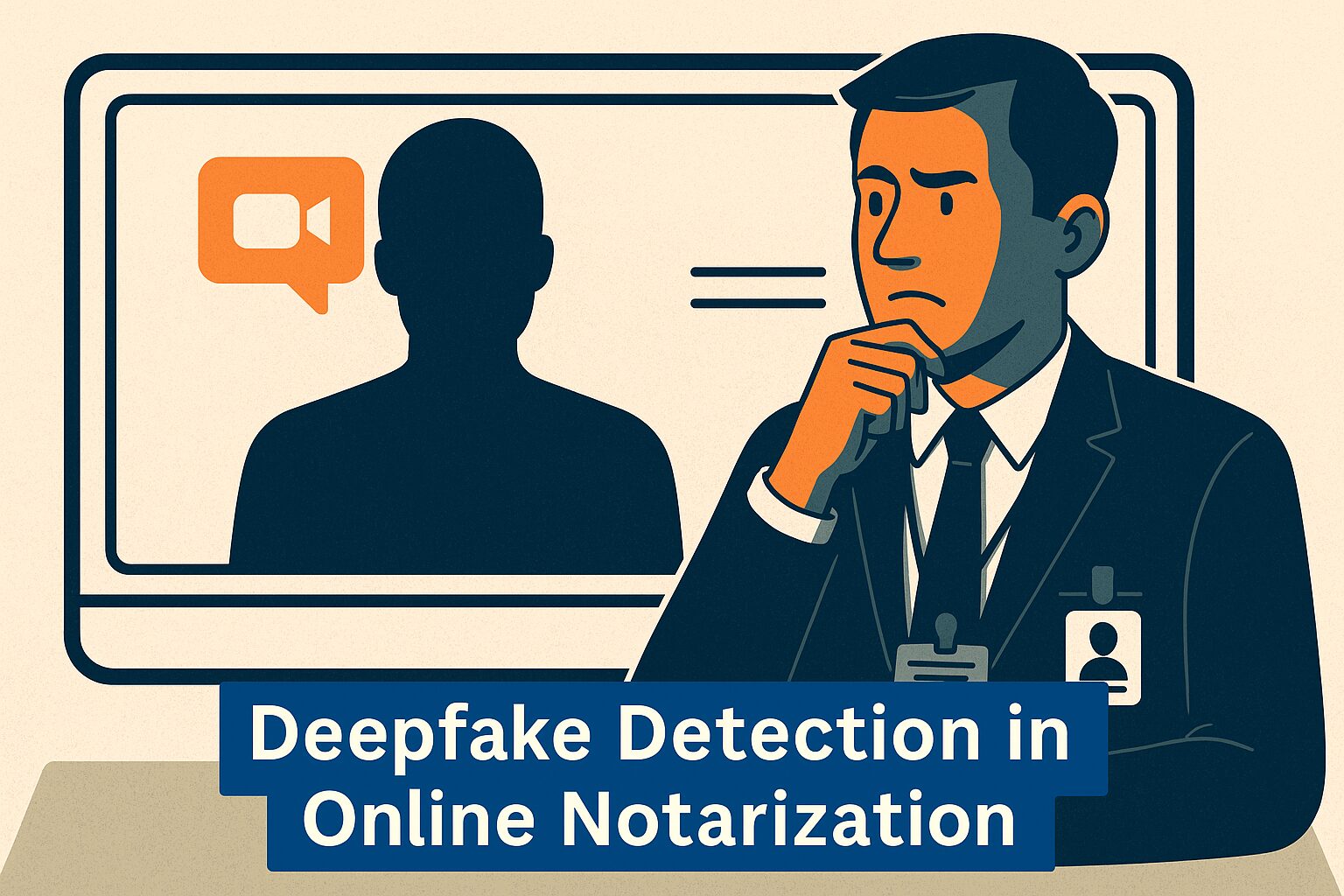
Deepfake Detection in RON: The Latest Buzzword Looking for a Problem to Solve
Real RON Fraud Is Low-Tech, Not Sci-Fi
Anyone who has handled more than a handful of Remote Online Notarizations knows that the real fraud threat doesn’t come from digital puppetry — it comes from real people with low-effort schemes.
- Paper-thin IDs that look like they came off a motel fax machine
- Birthdates that mysteriously “update” during questioning
- Webcams that somehow can’t focus when pointed at a driver license
- Signers drifting out of frame like cautious wildlife
- People volunteering to “just read what the ID says”
No machine learning. No neural networks. Just everyday human improvisation.
And consider the people online advertising that they will “legalize” documents — a term that shows they have absolutely no idea what a notary is or does. Fraudsters don’t need cutting-edge AI when a large supply of low-information notaries exists both on and off the internet.
Social Engineering: The Fraud Method That Shows Up Every Day
While some vendors are busy warning notaries about futuristic synthetic faces, the most effective fraud technique hasn’t changed in decades: social engineering. A real human applying pressure, deception, or misdirection is more dangerous in a RON session than any deepfake model on earth.
Here’s a real-world example: I once notarized a marital settlement agreement where the woman — wisely — asked to scroll through the document page by page on the shared screen. Halfway through, her expression changed. An entire extra page had been added without her approval.
The man looked like someone had unplugged his internal operating system. After the session, he actually called me demanding to know what I was “going to do with the video.”
And let’s address something directly, because some notaries misunderstand this: It is absolutely appropriate to remind signers they can take their time and review the document carefully — especially in adversarial situations. You’re not interpreting content. You’re not giving legal advice. You’re exercising professional vigilance in a high-stakes environment.
Fraud loves speed. Fraud hates daylight. Deepfake detection didn’t save that signer — a careful review did.
A Live Deepfake in a Two-Way RON Session? Not a Realistic Threat
Could someone produce a real-time deepfake capable of matching natural blinking, accurate micro-movements, expression syncing, full lighting consistency, and conversational timing — all inside a two-way RON session?
In theory: possible. In reality: not happening.
The latency alone would look like a 1999 video chat. Any expression jitter, frame tearing, or timing mismatch would be spotted instantly. A live RON session is not a filtered Instagram video — it’s an interactive, recorded examination.
Seller Impersonation Fraud Is the Real Crisis — Not Deepfakes
Real estate fraud today is driven by stolen identities, forged signatures, fake sellers, and mail-away documents. Deepfakes aren’t required — not even a little.
Here’s a detailed breakdown:
Seller Impersonation Fraud Explained →
And then there’s Home Title Lock — a company that built an entire business model around terrifying elderly homeowners into believing their “equity was stolen overnight,”
even though the product doesn’t actually prevent anything.
It’s fear-based marketing dressed up as protection, and now we’re starting to see versions of this same manipulation aimed at notaries.
Home Title Lock Scam →
When Weak Notaries Are Everywhere, Deepfakes Are Overkill
Fraudsters rarely attempt high-security RON sessions. Why would they when they can simply visit a location where the notary is:
- 18 years old
- trained for three minutes
- paid per signature or per customer
- afraid to slow down the line
This problem was worth its own deep dive:
Meet “The Stamper” →
Here’s the irony:
The platforms that would benefit most from deepfake detection
are often the least likely to implement it.
The side-giger waiting in a queue for an extra $7?
A sloppy deepfake — or an even sloppier real human — could breeze right through that model.
Deepfake Detection Isn’t RON Security — It’s Just Another Feature With a Big Spotlight
A strong verification workflow already includes:
- Biometric facial matching
- Liveness checks
- Strong credential analysis
- Document authentication layers
- Tamper-evident audit trails
- A notary who actually knows what they’re doing
Deepfake detection fits into this ecosystem — but it does not replace any of it.
Curious how a professionally run RON service actually handles identity, security, and compliance?
See How We Do RON the Right Way — Full-Time, No Notary Pools →
Real RON security is built on training, layered verification, and experience — not a single buzzword with a press release behind it.
🌴 Family-Owned in Florida | Trusted Worldwide
💼 Partner with Us — Join Our Affiliate Program.