November 26, 2025
Why Mobile Fingerprinting Is Rising (and When You Still Need In-Office LiveScan)
Mobile Fingerprinting Is Booming — But Not for the Reasons You Think
Mobile fingerprinting has exploded in popularity. Expats, remote workers, Puerto Rico applicants, international job seekers, and HR managers staring down onboarding deadlines all want the same thing: convenience.
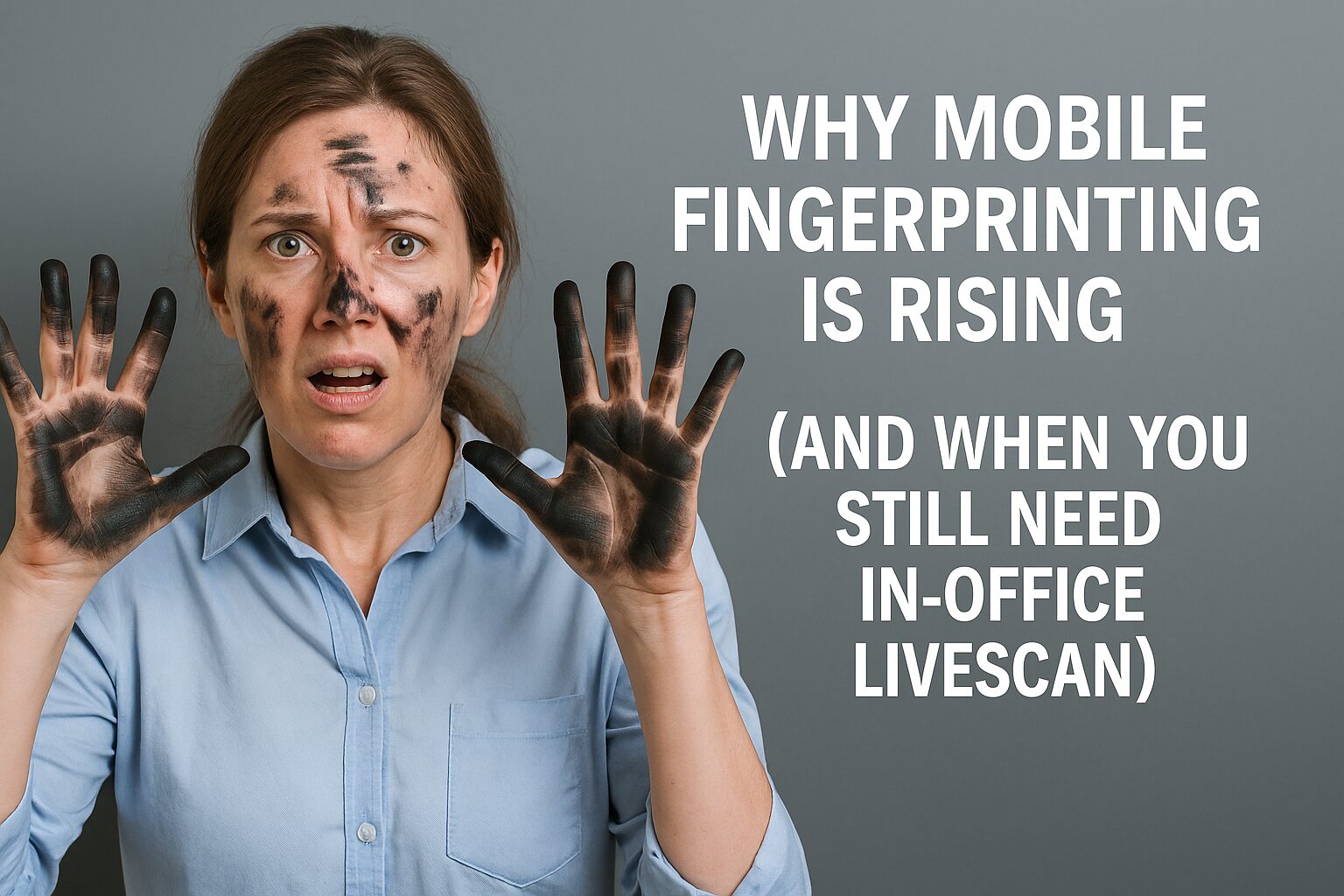
And for the right type of background check — particularly FBI Identity History Summary reports — a trained mobile fingerprint specialist can deliver perfect, agency-ready fingerprint cards right at someone’s kitchen table. This quality is made possible because modern ceramic-pad technology has buried the old “smudged ink everywhere” stereotype next to VHS tapes and floppy disks. It’s the same kind of upgrade that took us from dial-up internet to whatever your neighbor uses to stream Netflix in the driveway.
However, mobile service isn’t a universal substitute for the integrated LiveScan setup. Field-captured prints are fully compliant, but LiveScan keeps the photo capture and submission terminal in a single integrated workflow — which is why it remains the preferred approach for FDLE Level-2 and AHCA screenings that require a digitally captured photo bound to the electronic submission. While mobile service handles the capture flawlessly in the field, the in-office session is simply preferred because the necessary specialized camera equipment, professional background, and optimized lighting are already set up and integrated into a continuous process, ensuring maximum workflow efficiency for the technician and a faster, smoother experience for the customer.
What follows is a clear breakdown of when mobile fingerprinting is the perfect tool for card-based checks, when the screening requires electronic identity binding, and why equipment and technique matter more than most people assume.
Convenience & Demand
Why Mobile Fingerprinting Is Growing
The surge in mobile fingerprinting is driven by one factor above all else: convenience. Expats, professionals working abroad, remote employees, and HR teams onboarding multiple candidates at once appreciate the ability to complete fingerprinting without travel or schedule disruption.
Mobile appointments eliminate commutes, offer evening and weekend availability, and allow organizations to handle screening on-site. When the background check type accepts high-quality inked fingerprint cards, nothing is more efficient.
For many people, mobile fingerprinting is not just helpful — it’s the only practical option. The key is knowing when it fits the requirements and when the integrated LiveScan submission is preferred.
Compliance Requirements
FDLE Level-2 and AHCA: The Statutory Photo Requirement
FDLE Level-2 and AHCA background checks require a digital facial photograph that must be captured and submitted electronically with the fingerprint data. This is a statutory requirement for these screenings. Field capture is compliant, but the in-office LiveScan session remains the preferred method because the photo station and certified submission terminal are already integrated into a single workflow, eliminating multi-step handling and reducing the chance of submission delays. It’s the difference between using one machine or juggling three while hoping none of them decide to reboot mid-process.
Prints for these high-compliance checks aren’t accepted on mailed ink cards, so the process is completed through electronic submission.
Choosing the Right Method
When Mobile Fingerprinting Is Perfect — And When You Still Need In-Office LiveScan
Mobile fingerprinting shines for the FBI report and any background check that accepts inked fingerprint cards. It’s flexible, fast, efficient, and ideal for individuals, families, businesses, and applicants who can’t make it to an office.
But when a background check requires a digitally captured photo (FDLE Level-2, AHCA Clearinghouse, etc.), an in-office LiveScan visit is the preferred method. Field-captured prints are compliant, but LiveScan keeps the photo station and submission terminal in a single integrated workflow, reducing handling steps and minimizing submission delays.
Knowing when a check accepts inked cards and when it requires full digital submission prevents rejections and keeps the process fast and predictable. Mobile for everything compatible; LiveScan when integrated submission is required.
FBI Compatibility
Where Mobile Fingerprinting Truly Excels — FBI Identity History Summary Checks
If mobile fingerprinting has a “home field,” it’s the FBI Identity History Summary (IdHS). This report is used for a wide range of purposes, including international employment, residency visas, citizenship applications, federal contract work, adoption, apostilles, and countless expat requirements.
Unlike FDLE Level-2 and AHCA submissions, the FBI does not require a LiveScan-linked photo. It accepts high-quality inked fingerprint cards as long as the prints are clear, correctly rolled, and produced using the right materials. It’s one of the rare moments where the federal government keeps something simple, and Florida somehow doesn’t.
With modern ceramic fingerprint pads and trained technicians, mobile-captured inked cards provide the clarity the FBI expects for IdHS processing and are often the most convenient option for applicants. For many people, a mobile session is faster, cleaner, and more practical than traveling to a LiveScan location.
On-Site Capability
Taking LiveScan Into the Field — Group Screenings, Schools, and Workforce Events
Mobile fingerprinting isn’t limited to ink cards. When a large group needs Level-2 screenings — teachers, nursing students, healthcare staff, nonprofit teams, or contractors — Florida Document Specialists can transport fully-certified LiveScan equipment and photo stations directly to the site. It’s like bringing the whole office with us, minus the printer that jams only when someone’s watching.
LiveScan hardware and licensing are expensive and somewhat fragile, with high-quality stations often exceeding $10,000. But when a screening requires true LiveScan submission, bringing the equipment on-site keeps the process compliant, fast, and organized for large groups.
For organizations managing onboarding waves or semester-start requirements, on-site screening reduces scheduling bottlenecks, shortens lines, and improves the experience for everyone involved.
Mobile Identity Verification
Mobile KYC — The Same Identity Verification We Use In-Office
Most mobile fingerprinting providers stop at rolling the prints. Florida Document Specialists goes several steps further. Because we carry portable identity-verification scanning equipment, our specialists can perform the same Verified-KYC workflow in the field that we run in-office.
This includes credential analysis of the ID document, front-and-back authentication, biometric facial matching, liveness detection, and a full KYC report documenting that identity was verified properly. It’s everything you’d expect from an office check—just without the waiting room chair that squeaks every time someone breathes.
The result: mobile applicants receive the same identity verification standards and documentation we use for in-office LiveScan clients — a level of mobile capability rarely offered in the United States and especially valuable in Puerto Rico, Central America, and South America. For employers who want a copy of the KYC report for their compliance file, it can be provided with the applicant’s consent. KYC is always included as part of our standard workflow.
International Reach
Mobile Fingerprinting for Expats, International Applicants, and Global Use Cases
Not every applicant is in Florida. And not every applicant is even in the United States. Because FBI Identity History Summary checks accept high-quality inked fingerprint cards, people living abroad can benefit from the same mobile-grade print quality that we provide domestically.
Whether someone is pursuing residency in Europe, employment in South America, citizenship in Central America, or background checks for international contract work, professionally rolled fingerprint cards significantly reduce rejection risk — especially in places without reliable access to U.S.-standard fingerprinting. Some locations try hard, but a few still use equipment that looks like it retired around the same time as cassette tapes.
Puerto Rico is a perfect example. Without a local equivalent to FDLE maintaining state records, FBI checks are the primary background screening option. High-quality inked cards are in high demand, and mobile-grade print clarity makes the process faster and more reliable than many local alternatives.
When LiveScan Is Preferred
Need FDLE Level-2 or AHCA Screening? That’s When an In-Office LiveScan Is Preferred for Max Efficiency
For background checks that use a digitally captured photo bound to an electronic submission—including FDLE Level-2, AHCA Clearinghouse submissions, and ORIs with identity-binding rules—an in-office LiveScan appointment is the most streamlined and efficient way to complete the process.
Our office provides the hardware, photo systems, and certified submission software already integrated into a single workflow. Choosing LiveScan for these screenings minimizes handling steps, avoids multi-stage uploads, and reduces the chances of delays. This is not about accuracy—it’s about using the agency-preferred, fully integrated workflow that keeps the process fast and friction-free. Think of it as the difference between a direct flight and three layovers in airports that definitely weren’t built this century.
Ready to continue?
Schedule Your LiveScan Appointment →John Bayne
Co-Founder & CEO | Florida Document Specialists
📞 (386) 218-2523
Apostille Services | Online Notarization | LiveScan | eRecording
🌴 Family-Owned in Florida | Trusted Worldwide