Florida and Federal Apostille Services – Fast, Accurate, and Rejection-Free
Personally reviewed by specialists to ensure every document meets state or federal apostille requirements the first time.
Florida’s Premier Apostille Experts — Real People, Real Accountability
Speed, accuracy, and real accountability — the way Florida document work should be.
You get fast, carefully managed turnaround handled by a small Florida team that knows your name, your document, and exactly what must be done. No outsourcing, no handoffs, and no disappearing acts.
And unlike high-volume operations, you will never wait on a ticket number or argue with a chatbot that cannot tell a notary seal from a postage stamp — ever. Real people answer your questions.
Fast where it counts, meticulous where it matters — all handled by a Florida team you can actually reach.
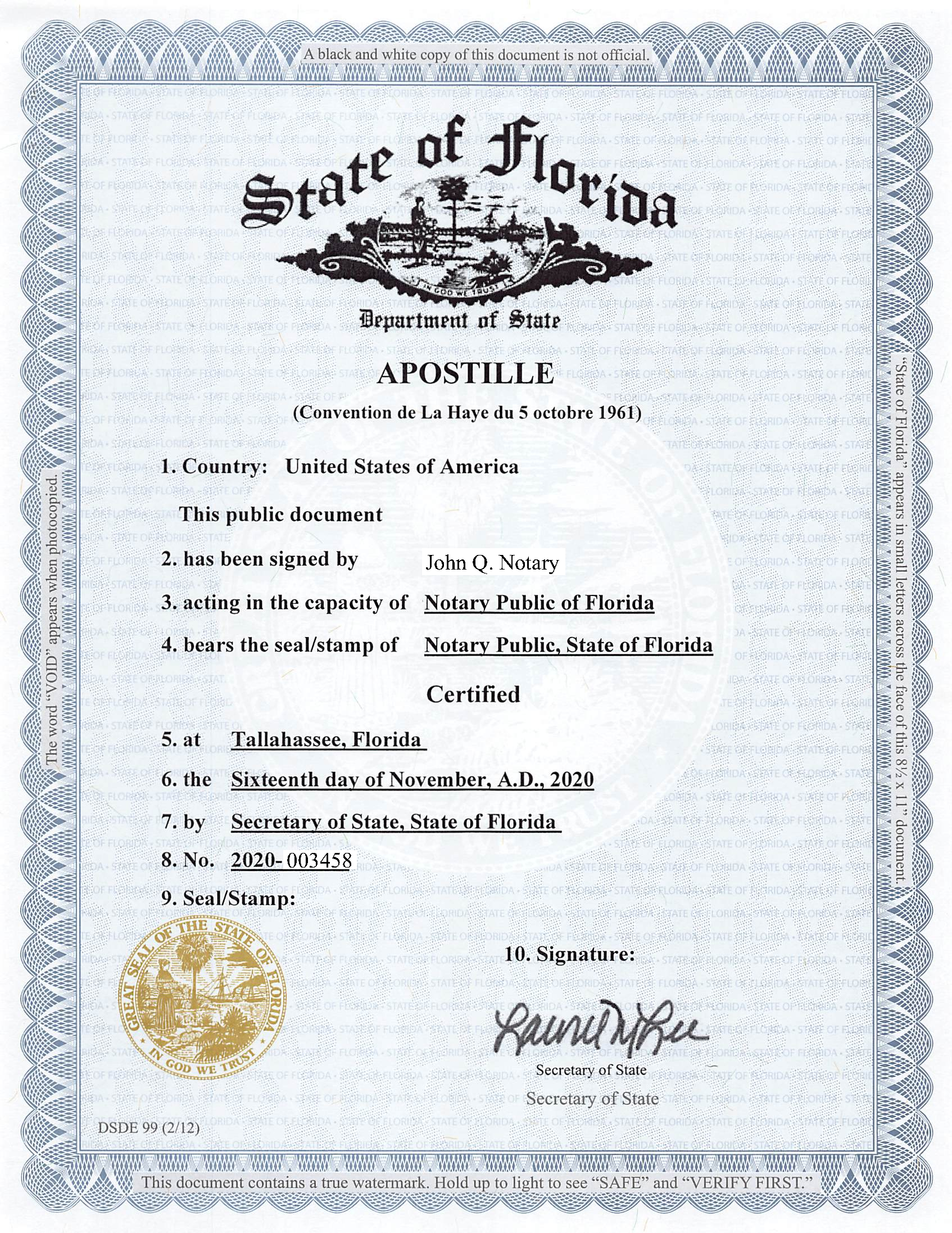
A Florida, Hague Compliant Apostille Certification Issued by the Florida Secretary of State.
Free Apostille Document Inspection — Avoid Rejection Before Submission
Not sure if your document is ready for apostille? Let our experts check it first — free of charge.
How to Begin
Upload your document for a complimentary review before you spend extra time, money, or patience. We take a quick look up front so you are not guessing in the dark.
We do not just glance at the notarial block. We also look at how the document was prepared and handled in the first place, because every agency seems to think it is its own little sovereign nation with its own rules. We will tell you right away if everything looks good or if it needs a quick tune-up.
What You Will Receive
- Confirmation that your document qualifies for apostille.
- Simple, practical steps to fix any issues we spot.
- Guidance on whether our Online Notary can correct it immediately.
- A brief roadmap tailored to your document type and destination.
Why This Matters
Most apostille delays come from small, preventable mistakes. Our free inspection catches them early so you do not end up mailing Tallahassee a surprise they will cheerfully return to sender.
⏱️ Turnaround: Most inspections are reviewed the same business day. For urgent cases, call us directly at (800) 255-5287 — you’ll reach a real Florida specialist who can help right away.
Expedited Florida Apostille Services — Certified, Accurate, and Reliably Fast
Fast, accurate Florida apostille processing — reviewed and handled by real specialists.
We provide comprehensive Hague Apostille and authentication services for all Florida document types—including birth certificates, marriage certificates, powers of attorney, school transcripts, and court documents. We process all orders directly through the Florida Department of State Apostille Section.
Every document is verified by our in-house specialists before submission to ensure every seal, signature, and stamp meets Florida’s exacting standards for international use under the Hague Convention. This meticulous review is how we maintain our near-zero rejection rate and industry-leading turnaround times.
Fast Florida apostille processing handled entirely by real Florida specialists — ensuring your document is done right the first time and accepted worldwide.
A Trusted Partner
High-trust document handling for clients who expect precision and discretion.
We regularly serve attorneys, wealth managers, title companies, and multinational corporations who depend on us for fast, accurate, and confidential Florida apostille processing.
From your first inquiry to final delivery, you’ll have a dedicated specialist managing your entire process. We proactively update you at each step and guarantee accuracy the first time.
We also simplify complex, multi-step international requests by coordinating online notarization, certified translation, and return shipping under one roof — saving you time, confusion, and cost.
Our clients depend on us for apostille services in Florida that combine precision, accountability, and personal attention.
Integrated Support: Notarization, Translation, and Global Delivery
-
International Delivery Made Simple
We offer discounted global FedEx and DHL shipping rates for secure delivery anywhere in the world. From Florida to France or Colombia to Korea, your apostilled documents arrive safely and quickly — often for less than you’d pay retail.
-
Online Notarization Tailored for Apostille Requirements
If your document needs notarization before certification, our award-winning Online Notary service is your fastest option. We serve clients in more than 100 countries — no U.S. Social Security number required — ensuring your notarized documents meet all standards for international use.
-
Certified & Sworn Translation Services
If the foreign authority requires translated documents, our network offers certified translation in 95 languages. For specific jurisdictions, such as Spain, we provide the required sworn translation services, ensuring your documents meet the rigorous local compliance standards for global acceptance.
One Team. One Point of Contact.
Personalized support with absolute transparency.
Some projects are straightforward. Others involve multiple steps like legalizing document text, managing secure digital signings, or certifying foreign translations. That’s where we come in. We take immense pride in working directly alongside you with absolutely zero hidden fees or surprise costs. Because we value straightforward relationships, please note that the tiers listed below cover the structured apostille processing itself. Independent complementary services—such as digital Remote Online Notarizations (RON) or professional translations—are billed separately as dedicated options so you only ever pay for exactly what your specific paperwork requires.
Transparent Florida Apostille Pricing
Clear tier options with zero creative asterisks or checkout surprises. The pricing below represents our flat rates for state and federal authentication processing.
⚠️ Important Note: The standard rates shown below cover the apostille processing itself. Documents requiring a Remote Online Notary (RON) session beforehand, or certified translations after the apostille is issued, are independent services. Those fees are invoiced separately and are not included in the baseline apostille tier quotes. For details, please review our standalone RON and Translation Pricing Guide.
Same Day
The fastest way on the planet to Apostille a Florida document
- 🔹 $135 For Each Addt’l
- 🔹 Government Fees Included
- 🔹 Complimentary Digital Scans
- 🔹 Free U.S. Return by FedEx Overnight
- 🔹 International Delivery Available
1-2 Business Days
Skip the Hassle: 93% Faster Process Compared to DIY
- 🔹 $99 For Each Addt’l
- 🔹 Government Fees Included
- 🔹 Meticulous In-House Compliance Check
- 🔹 Free U.S. Return by FedEx 2-Day
- 🔹 International Delivery Available
Less Than 5 Days
Fast and reliable processing through the Florida SOS
- 🔹 $79 For Each Addt’l
- 🔹 Government Fees Included
- 🔹 Standard State Submission Check
- 🔹 Free U.S. Return by FedEx 2-Day
- 🔹 International Delivery Available
Less Than 20 Days 🕊️
Don’t risk costly rejections — let our document specialists manage your process
- 🔹 $49 For Each Addt’l
- 🔹 Thorough Pre-Apostille Verification Review
- 🔹 Government Fees Included
- 🔹 Includes FedEx 2-Day Return Shipping
- 🔹 International Delivery Available
* All Florida state processing times listed exclude inbound mail transits to our office and outgoing shipping returns.
U.S. Department of State Apostille & Authentication
Direct federal processing for U.S. Government agency records (including FBI IdHS Background Checks). We manage the required U.S. Department of State Hague Apostille certification, or legalization for non-Hague countries, ensuring your documents are ready for international use.
🏛️ Non-Hague Embassy Legalization:
If your destination country is not a member of the Hague Convention (such as the UAE, Egypt, or Kuwait), our specialist team manages the entire multi-step embassy legalization structure for you as a seamless add-on service.
The Boutique Advantage: Real People, Real Accountability
We are not a call center, and we never outsource your records. Every document is personally reviewed by a Florida-based specialist who verifies each seal, notary signature, and statutory venue stamp for compliance before final submission to government authorities.
What Sets Our Service Apart:
Direct Access: You communicate directly with the dedicated specialist managing your filing—not a chatbot, third-party ticket system, or generic answering service.
Local Expertise: Your paperwork is handled right here in Florida by working professionals who deal with the Department of State’s changing standards daily.
Precision Routing: Our hands-on review method catches missing elements, flawed notarizations, and improper certifications early to ensure an error-free path through government channels.
Direct Accountability: We track the files, update you as changes occur, and see the assignment through until the final authenticated records are in your hands.
That is why corporate legal departments, relocating families, and international professionals rely on Florida Document Specialists to manage their state and federal apostilles correctly the first time.
Frequently Asked Questions About Florida Apostilles & Electronic Wills
If you have searched online for help with apostilles or digital legal frameworks, you already know how confusing and inconsistent the information can be. Below are clear answers directly from real Florida specialists who work with state legalities, remote online notarization, and the Department of State every day. Whether you need details about state fees, turnaround times, or establishing a valid electronic will, this guide explains exactly how these processes work—and how Florida Document Specialists makes them straightforward, secure, and legally precise.
How long does a Florida apostille take?
Our processing times depend on the service tier you select. Most orders are completed in just a few days, and every option includes government fees and FedEx return shipping. Even our most affordable "Peace of Mind" tier is faster and far more reliable than mailing it yourself.
The Florida Department of State says apostilles take 30 days — how can you do it faster?
It’s a fair question. The 30-day estimate on the state website applies to mailed-in requests, which sit in the processing queue with thousands of others. Our process is different. We hand-deliver your documents directly to the Florida Department of State in Tallahassee, wait in line, and pick them up the same or next business day. That’s why our turnaround times are measured in days instead of weeks — and why we’re able to maintain near-zero rejection rates.
How does your same-day apostille service work?
Our Same-Day Apostille Service is available for time-critical situations and depends on several factors, including document type, time of submission, and state office availability. When conditions align, we’re often able to complete the entire process and ship your finalized documents the very same day.
Because some factors — such as Department of State operating hours, weather, and courier schedules — are outside of our control, same-day completion is not guaranteed in every case. If we’re unable to complete the service within that window, your order automatically transitions to Rush Service (2–3 business days) and we refund the price difference immediately.
Do you guarantee turnaround times or offer refunds if there’s a delay?
We guarantee everything within our control — accuracy, proper document preparation, and prompt delivery to the Florida Department of State. However, once your documents are submitted, a few factors are outside anyone’s control.
Occasionally, the Department of State may close unexpectedly due to weather, power outages, or other statewide issues. Delays can also occur if FedEx or DHL misroutes or loses a shipment.
Because of these rare but real variables, we can’t offer a money-back guarantee based solely on turnaround time. What we do guarantee is responsive, human support — if something goes wrong, you’ll always be able to reach a real Florida specialist who will help resolve it quickly.
How much does the Florida Department of State charge for an apostille?
The State of Florida charges $10 per apostille, or $20 for county-certified documents like marriage certificates.
If you’re considering doing it yourself to save money, that’s understandable — but be aware that unless you’re familiar with Florida’s strict notarial and certification rules, rejections are extremely common. The state’s mail-in process can take 30 days or more, and if your documents are rejected, you’ll wait another month just to try again.
That’s why we created our Peace of Mind service — for customers who aren’t in a rush but want everything done correctly the first time. It’s an affordable option that includes professional inspection, preparation, and handling from start to finish, so your documents are accepted without costly delays.
What happens if my document gets rejected by the State of Florida?
If you submit your apostille request directly to the State and it’s rejected, your documents are mailed back without processing — usually after a 30-day wait. The most common causes are missing seals, incorrect notarial wording, expired commissions, or improper county certifications. Unfortunately, the State doesn’t correct these issues for you, and you’ll need to start the process over from the beginning.
When you use Florida Document Specialists, that never happens. Every document is reviewed by trained Florida-based specialists before submission to ensure it meets every requirement. And if you’re not in a rush, our Peace of Mind service gives you the same expert handling at a lower price — so your apostille gets accepted the first time, guaranteed.
What types of documents can receive a Florida apostille?
Almost any Florida-issued or notarized document can qualify — including birth, marriage, and death certificates; school transcripts and diplomas; powers of attorney; corporate filings; and notarized personal documents. If you’re unsure, our specialists can review it for free before you order.
Why do documents get rejected for apostille?
Most rejections come from simple technical errors — missing notary seals, incorrect wording, or ID mismatches. In fact, we correct these issues in about 80% of documents we review. Using our inspection and handling service nearly eliminates that risk.
What’s the difference between a Florida apostille and a federal apostille?
A Florida apostille authenticates documents issued or notarized within Florida. A federal apostille (through the U.S. Department of State) is for federal documents, such as FBI background checks. We handle both types and can guide you to the correct option for your situation.
Can I get a Florida apostille at a consulate or a local office?
No — the Florida Department of State in Tallahassee is the only authority that issues authentic Florida apostilles.
There are no branch offices in Miami, Jacksonville, Orlando, or anywhere else, and foreign consulates in Florida cannot issue apostilles under the Hague Convention.
Many people are misled by third-party websites or walk-in "document centers" that claim to provide "Florida apostilles near you." In reality, those companies still send your paperwork to Tallahassee — often with extra markup and no quality control.
At Florida Document Specialists, we hand-deliver your documents directly to the Department of State, so you get genuine, verified apostilles — quickly, safely, and without middlemen.
Can you help with notarization before apostille?
Yes. If your document requires notarization, our award-winning online notary team can complete it for you in minutes. You’ll receive a properly executed digital document that meets all Florida Department of State standards for apostille processing.
Is an apostille the same as notarization?
Not exactly. Notarization confirms that a signature or statement is genuine, while an apostille verifies that the notary or issuing authority is officially recognized. Many documents need both — and our team can handle both steps under one roof.
What if my document isn’t in English?
If your document or its destination country requires translation, we can coordinate certified or sworn translation services in 95 languages. That way, your apostilled document meets every international standard for acceptance.
Can I get an apostille if I’m outside the United States?
Yes — we work with clients in more than 100 countries. You can upload your documents securely online, and our Florida-based specialists will process the apostille and ship it back to you by FedEx or DHL, anywhere in the world.
Do you ship apostilled documents internationally?
Absolutely. We offer discounted FedEx and DHL global delivery, with tracking and signature confirmation. Whether your documents are headed to Spain, Brazil, or South Korea, we’ll make sure they arrive securely and on time.
Will I be able to speak with a real person if there’s a problem?
Absolutely. That’s one of the biggest differences between Florida Document Specialists and large nationwide processors. You’ll never be routed through a call center, sent to voicemail loops, or told to "open a support ticket."
When you call us, you’ll speak directly with a trained Florida specialist who knows your order and can resolve your issue on the spot. Whether it’s a shipping delay, a question about notarization, or tracking an apostille already in progress, we’re here — by phone, email, or live chat — until everything is handled.
That’s the concierge-level service our customers count on, and why so many law firms, businesses, and families choose to work with us again and again.
What is a Florida electronic will?
A Florida electronic will is a legally valid will that is created, signed, witnessed, notarized, and stored in digital form. There is no paper original. The electronic file itself is the official will.
Are electronic wills legal in Florida?
Yes. Florida law allows electronic wills when they are executed in compliance with Chapter 732 and the remote online notarization requirements in Chapter 117. When done correctly, they carry the same legal effect as a traditional will.
How do I create an electronic will in Florida?
To create a Florida electronic will, you must sign your will during a live online notarization session with a Florida notary and two witnesses. The process includes identity verification, a recorded signing ceremony, and proper execution under Florida law. It is not enough to sign a PDF or upload a document. The execution must follow the statutory procedure for electronic wills and remote online notarization.
Can I make a will online in Florida without going to an attorney?
You can complete the execution of a will online using a Florida online notary, but legal advice and document preparation are separate issues. The execution must still follow Florida law, including proper witnessing, notarization, and custody.
How is an electronic will signed in Florida?
The will is signed electronically during a live audio-video session with a Florida online notary and two witnesses. All parties must be present in real time, and the notary supervises the signing process from start to finish.
Can I sign my Florida will online from another state or country?
Yes. You can sign from anywhere, including outside the United States, as long as the notary is physically located in Florida and the session complies with Florida’s remote notarization requirements.
Do I need witnesses for an online will in Florida?
Yes. Florida requires two witnesses for both electronic and traditional wills. Remote witnesses are allowed if the statutory requirements are followed.
Are remote witnesses allowed for Florida electronic wills?
Yes, but they must be physically located within the United States or a U.S. territory, and the session must comply with Florida’s remote witnessing rules.
How does remote online notarization (RON) work for wills in Florida?
Remote online notarization uses secure audio-video technology to verify identity, conduct the signing ceremony, and record the session. The notary oversees the process and ensures compliance with Florida law.
How is identity verified for an electronic will signing?
Identity is verified using government-issued identification combined with credential analysis and biometric identity proofing to confirm the signer’s identity during the session.
What happens during a Florida electronic will signing ceremony?
The signing is a formal legal ceremony conducted by the notary. The notary verifies identity, confirms all participants are present, and guides the testator and witnesses through the required acknowledgments. The testator must declare that the document is their will and that they are signing voluntarily. The witnesses observe this acknowledgment and sign in the correct sequence while connected live.
What questions are required during an electronic will notarization in Florida?
Florida law requires specific questions to be asked when remote witnesses are used. These include questions about whether the signer has any impairments, who is present in the room, whether anyone assisted with the session, and whether anyone helped prepare the document. These questions must be asked on the record and are part of the legal validity of the process.
Can I sign an electronic will if I am elderly or need assistance?
Possibly, but Florida law places specific safeguards around what it calls a “vulnerable adult” when remote witnessing is involved.
A vulnerable adult generally refers to someone whose ability to perform normal daily activities or care for themselves may be impaired due to age, illness, disability, or cognitive limitations. This does not automatically prevent someone from signing a valid will. Capacity is still the key legal standard. However, it does affect how the will can be executed.
When a Florida electronic will is being signed using remote witnesses, the law requires the signer to answer screening questions about impairments, need for assistance, and living conditions. These questions are designed to identify situations where the signer may be at higher risk of undue influence or coercion.
If the signer indicates certain conditions—such as needing assistance with daily care or having impairments that affect independence—Florida law does not allow the use of remote witnesses for that execution. In those cases, the will can still be signed, but the witnesses must be physically present with the signer at the time of execution.
This is an important distinction. The law is not saying the person cannot sign a will. It is saying that a fully remote execution is not appropriate in those circumstances, and additional in-person safeguards are required.
The notary is required to ask these questions on the record and evaluate the responses as part of the ceremony. If the answers trigger the statutory restriction, the process must shift to a format that includes physically present witnesses to ensure the will is valid and defensible.
Is the electronic will signing session recorded?
Yes. Florida law requires the entire audio-video session to be recorded and retained.
Why is the recording important for an online will?
The recording provides evidence of identity, intent, and proper execution. It can be critical if the will is ever challenged in probate.
What is a self-proving electronic will in Florida?
A self-proving will includes sworn statements from the testator and witnesses, allowing the will to be admitted to probate without requiring testimony later.
How do I make my electronic will self-proving?
This is done during the notarization ceremony when the notary administers the required affidavits and ensures the correct statutory language and procedure are followed.
What is a qualified custodian for a Florida electronic will?
A qualified custodian is the entity responsible for storing and maintaining the electronic will after it is signed.
Do I need a qualified custodian for my electronic will?
Yes. Under Florida law, an electronic will must designate a qualified custodian in the will itself in order to be self-proving.
This is not optional language or a best practice. It is a statutory requirement. If the will does not designate a qualified custodian, it is not self-proving.
A self-proving will is what allows the document to be admitted to probate without having to locate witnesses or present additional testimony. Without that status, the court can require proof of execution, which introduces delay, cost, and potential complications.
The qualified custodian is the party responsible for maintaining the original electronic will and the associated records, including the notarization and execution data. Florida law requires that the custodian maintain the will in a secure system and preserve its integrity over time.
Because an electronic will has no paper original, the legal system relies on this controlled custody to establish authenticity. That is why the designation must be included in the will itself. It ties the document to a specific custodian who can later certify and produce the will when needed.
If the will does not include a qualified custodian designation, it does not meet the statutory requirements for a self-proving electronic will.
What does a qualified custodian actually do?
They securely store the original electronic will, maintain associated records, and ensure the document remains intact and unaltered.
Can I store my electronic will myself?
No. Personal storage breaks the chain of custody and undermines the legal reliability of the document.
What happens if my electronic will is not stored correctly?
It may lose its self-proving status and could require additional legal steps to validate in probate.
Is an electronic will safer than a paper will?
When done correctly, an electronic will provides strong protections through identity verification, recorded execution, and controlled custody.
Why is custody just as important as signing the will?
Because signing creates the will, but custody preserves it. Without proper custody, the electronic will may not hold up when it is needed.
How do I get started with a Florida electronic will?
You begin by preparing your will document, then scheduling a compliant online notarization session with witnesses and a Florida online notary.
Are my electronic will and estate planning documents kept confidential?
Yes. Your electronic will and any related estate planning documents are stored using a secure, encrypted system designed specifically for highly sensitive records.
FDS uses Tresorit secure vault storage, a zero-knowledge, end-to-end encrypted platform. Zero-knowledge encryption means that the platform itself cannot access or read your files. Your documents are encrypted before they are uploaded and remain encrypted at all times unless accessed by an authorized party.
This structure creates a clear separation of access. The storage provider cannot view your electronic will or estate documents, and your files are not exposed to third parties, scanning systems, or data mining. At the same time, FDS maintains controlled access as the designated qualified custodian so we can meet our legal obligations, including preserving the original electronic will and producing certified copies when required for probate.
All access is restricted, monitored, and limited to authorized use only. Your records are not publicly accessible and are not stored in open or unsecured environments.
In practical terms, your electronic will and estate documents are protected by both Florida’s qualified custodian requirements and advanced encryption technology, ensuring confidentiality while still maintaining the ability to retrieve and certify the document when it matters.
Contact Our Florida Apostille Specialists
📑 Documents That Commonly Require an Apostille
- Birth certificates
- Death certificates
- Marriage certificates
- Divorce certificates
- Adoption papers
- Diplomas
- School Transcripts
- Degrees
- Professional licenses and certificates
- Power of attorney documents
- Corporate documents, such as articles of incorporation/organization and certificates of status
- Patents and trademarks
- Wills and trusts
- Affidavits and declarations
- FBI Criminal background checks and police clearance certificates
- Court documents, such as judgments, orders, and decrees
- Notarized letters and documents
- Deeds and property titles
- Military records
- Medical records
- Financial documents, such as bank statements and tax returns
- Employment records, such as letters of employment and termination letters
- Immigration documents, such as visas and residency permits
- Vehicle titles and registration documents
- Travel documents, such as passports and child travel consent authorizations
- Certificates of good conduct
- Certificates of origin
- Bills of sale
- Trade licenses and permits
- Insurance documents, such as policies and claims records
- Proof of residency documents, such as utility bills and rental agreements
- Adoption certificates
- Trust deeds and wills
- Consents and authorizations
- Home studies and evaluations
- Letters of reference and recommendation
- Business agreements and contracts
- Social security statements and benefit verification letters
- Academic records for homeschooling or online education
- Documentation for importing/exporting goods